
Hardware Security Modules (HSMs) have become a foundational element of modern enterprise security. These tamper-resistant appliances provide the highest level of protection for sensitive cryptographic material, automatically destroying keys if unauthorized access is detected. For security-mature organizations, investing in HSMs is an easy decision.
Yet most organizations use their HSMs for only a small fraction of the use cases they support. As a result, they leave significant security benefits—and ROI—on the table. This article outlines where HSM usage typically falls short and how enterprises can fully unlock the value of their investment.
Where HSMs Are Commonly Used Today
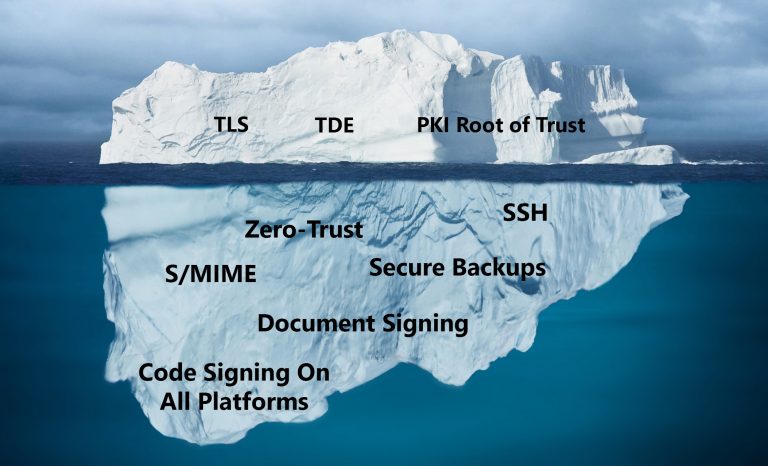
These are important and appropriate use cases—but they represent only a small subset of what HSMs are capable of.
In reality, HSMs and key managers are significantly underutilized. With cloud adoption accelerating and key sprawl increasing, centralizing key protection in hardware is more important than ever.
Expanding HSM Usage Across the Enterprise
Cryptographic keys underpin nearly every security-sensitive workflow: authentication, encryption, digital signatures, and more. Any organization already operating HSMs has an opportunity to extend hardware-backed protection to every cryptographic operation—if the right tooling is in place.
Expanded HSM usage can support:
SSH key storage and authentication
S/MIME and PGP email encryption
Encrypted backups before cloud transfer
Digital document signing
Zero-trust architecture key enforcement
Code signing across all platforms
Encryption for data in transit
Database and application-level key protection
Done correctly, HSMs become the backbone of enterprise-wide cryptographic governance, improving confidentiality, integrity, and non-repudiation in every critical workflow.
Why Most Organizations Don’t Fully Leverage Their HSMs
If HSMs offer so many benefits, why aren’t they used everywhere?
Three primary barriers exist:
1. Custom Development Is Expensive and Risky
Integrating applications with HSMs requires development against low-level cryptographic APIs (PKCS#11, JCE, CAPI/CNG).
These interfaces are powerful—but specialized and notoriously difficult to implement correctly.
For most enterprises, cryptographic development is not a core competency, making in-house integration:
Costly
Time-consuming
Error-prone
Difficult to maintain
2. Poorly Designed Integrations Hurt Performance
HSMs are secure but slower than software.
If integrations aren’t architected with techniques like client-side hashing or asynchronous signing, HSM usage can:
Slow CI/CD pipelines
Create API bottlenecks
Fail under high transaction volumes
This leads teams to avoid integrating more workloads—even when it would significantly improve security.
3. Lack of Centralized Cryptographic Governance
Enterprises often manage keys separately across teams and tools.
Without a single, unified control point, expanding HSM usage becomes operationally complex.
A Turnkey Solution to Maximize HSM ROI
What enterprises truly need is not more engineers writing custom crypto code—it’s a platform that connects their existing tools directly to their HSMs, securely and efficiently.
That’s exactly why we built GaraTrust.
GaraTrust unlocks the full value of your HSMs by providing:
✓ Native client integrations
Seamlessly integrates with the tools and platforms you already use (Windows, macOS, Linux, OpenSSL, GPG, RPM, Java, code signing utilities, and more).
✓ Zero custom development required
No low-level cryptographic programming. No proprietary SDKs. No risk of incorrect implementations.
✓ HSM-backed cryptographic operations across all use cases
Every key stays in hardware. Every operation is proxied and controlled.
✓ High performance through hash signing
Accelerates digital signatures and prevents HSM bottlenecks—even in high-volume CI/CD pipelines.
✓ Centralized policy enforcement
MFA, device authentication, approval workflows, logging, and auditability are applied consistently across all key usage.
Get More From the HSM Investments You’ve Already Made
Most enterprises are using only 10–20% of their HSMs’ capabilities. With the right platform, organizations can:
Expand cryptographic protection across every business unit
Reduce key sprawl and eliminate unmanaged keys
Strengthen zero trust and identity strategies
Improve compliance and audit readiness
Increase ROI from existing HSM infrastructure
GaraTrust makes this possible—without rewriting applications, slowing systems, or adding operational burden.