
Ensuring the security and performance of digital signatures is a top priority for InfoSec and DevSecOps leaders. With many organizations shifting to remote work during the global pandemic, this responsibility has become even more challenging.
How do you maintain strong digital signature security across a fully remote workforce—without sacrificing performance?
Digital Signatures For Distributed Teams
As companies adopt work-from-home policies to protect employees, securing digital signatures for a widely distributed team becomes mission-critical. Strong authentication, reliable signing performance, and centralized control are all essential to keeping operations running smoothly.
When enabling digital signatures for a remote or hybrid workforce, organizations typically consider three approaches:
Store private keys in software and distribute them to employees.
Place private keys in hardware devices (HSMs) and deploy multiple HSMs across teams.
Store private keys in a centrally managed HSM and provide proxied access to all end users.
Option 1 carries significant security risks and should be avoided. Software-based keys can be copied, stolen, or extracted from compromised devices.
Option 2 improves security, but it is costly and operationally complex. Purchasing and managing several HSMs, keeping them synchronized, and maintaining consistent key management across multiple devices can quickly become a burden.
Option 3 offers the most secure and scalable approach—if it can deliver strong performance. This is where hash signing becomes invaluable.
What Is Hash Signing?
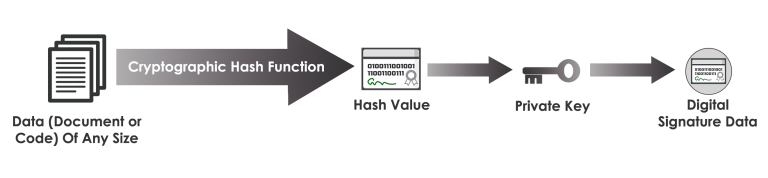
The term “hash signing” can be confusing because all digital signatures involve hashing in some form. Typically, the data to be signed is first hashed, and the private key operation is applied to that hash to create a signature.
A cryptographic hash function produces a fixed-length “fingerprint” of the data. This allows verifiers to detect any modifications made after the signature is created.
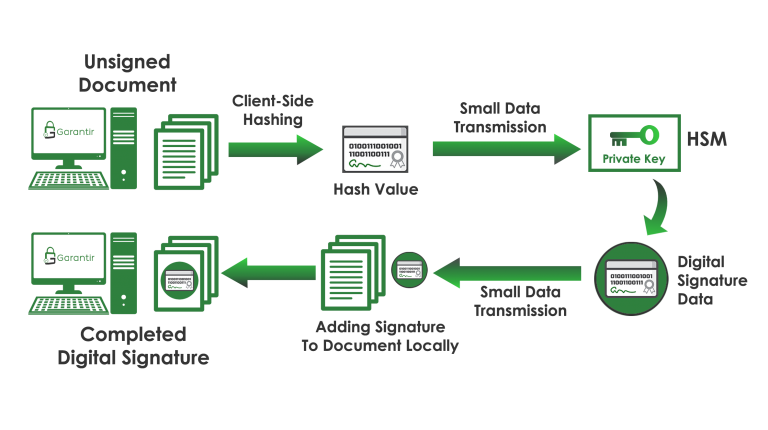
Importantly, the private key is only needed after the data has been hashed. This means organizations do not need to send the full dataset to a signing server. Instead, employees can hash files locally and send only the resulting hash to the signing server for final signature creation.
This method—client-side hashing—is known as hash signing, and it dramatically improves the performance of remote digital signatures.
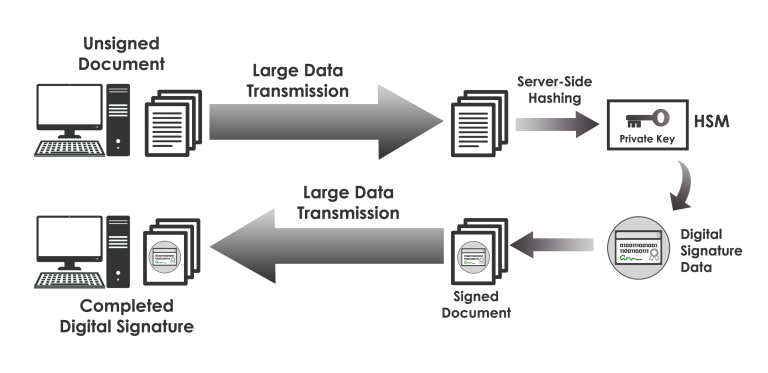
Without hash signing, organizations storing private keys in centralized HSMs must upload entire files to the signing service and download them again after signing. For large files, like installers or documents, this leads to slow processing and heavy bandwidth usage.
With hash signing in place, only a small hash is sent over the network, significantly reducing data transfer and speeding up the signing process.
Challenges with Hash Signing
1. Client Integrations
Many existing signing tools assume the signing key is stored locally. Similarly, traditional HSM APIs expect the data to be signed to exist on the machine directly connected to the HSM.
Deploying a hash-signing architecture—while keeping private keys securely locked inside enterprise HSMs—is a complex task that requires deep cryptography expertise and low-level development work.
This is where GaraTrust shines.
GaraTrust includes ready-to-use cryptographic providers and integrations for a wide range of platforms, including:
Apple
Microsoft
Java
Android
GPG
RPM
Linux
OpenSSL
And more
Whether signing code, documents, challenge-response data, or other digital assets, GaraTrust’s integrations make the process seamless for end users.
2. Security
With hash signing, the signing server receives only the hash—not the original data—which means the server cannot inspect the full content being signed.
To address this, Garantir built essential security features into the GaraTrust platform, such as:
Strong authentication and authorization
Approval workflows for high-value keys
Optional code analysis through source code repositories
Additional policy-driven security controls
These capabilities help maintain the integrity of the signing process without exposing private keys or sensitive data.
Experience the Benefits of GaraTrust
GaraTrust improves both the security and performance of digital signatures across remote, hybrid, and enterprise-scale environments. Although GaraTrust is customer-managed, the Garantir team offers a free hosted proof of concept, allowing organizations to experience its speed, integrations, and ease of deployment firsthand.