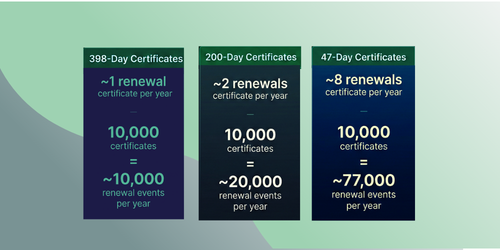
The compression of certificate lifecycles from 398 days to 200 days, and ultimately to 47 days, is not just an operational adjustment. It represents a structural shift in how enterprise cryptography must be managed.
As we explained in The New Economics of Certificate Lifecycle Management, shrinking certificate lifetimes are transforming certificate operations across modern infrastructure.
Most organizations are already aware of the mandate. The more important question is operational:
Can your certificate lifecycle management platform sustain continuous renewal without introducing risk or service disruption?
Short-lived certificates do not simply increase renewal frequency. They expose architectural weaknesses. Manual processes break first. Script-based orchestration becomes brittle. Per-certificate pricing models become economically impractical.
In a 47-day lifecycle model, automation must be native to the platform architecture.
Renewal Frequency Is Not the Real Challenge — Deployment Is
At shorter lifecycles, renewal becomes continuous. Issuing certificates more frequently is not inherently difficult. The challenge is safely deploying them across production infrastructure.
Renewal typically triggers a series of operational steps: rebinding certificates to application services, updating load balancers, validating policy, and reloading configurations while maintaining service availability. When these steps rely on manual intervention or external scripting, operational complexity grows with the number of certificates under management.
Modern CLM platforms address this by embedding orchestration capabilities directly within the system rather than relying on external tooling.
The goal is to shift certificate renewal from a visible operational event to a background infrastructure process governed by policy.
What Zero-Downtime Certificate Automation Requires
Achieving automated renewal without service disruption depends on several architectural capabilities working together.
Modern implementations typically include:
- Agentless integrations for supported services
- Native orchestration across common infrastructure such as Apache, NGINX, Tomcat, F5, and cloud environments
- Policy-driven renewal thresholds
- Automated certificate rebinding and graceful service reload where supported
- Secure private key handling within Hardware Security Module (HSM) boundaries
- Continuous discovery to identify unmanaged certificates
When these functions are integrated into the platform itself, renewal workflows can execute automatically according to policy, reducing operational overhead and minimizing the risk associated with manual processes.
Platforms that rely heavily on external scripting or layered automation tooling may find that complexity increases as certificate volumes grow.
See Server-Side Push Automation in Action
Architecture claims are easy to make. Execution is what matters in production environments.
The short technical walkthrough below demonstrates server-side push automation within the GaraTrust platform, including policy-based renewal and automated certificate deployment to supported services.
The demonstration shows how certificate renewal can trigger automated rebinding and service reload processes designed to maintain service continuity.
At scale, this type of integrated orchestration becomes a critical requirement for maintaining operational stability.
The March 2026 Shift Is a Catalyst — Not the End State
The transition to 200-day certificate lifespans in March 2026 will push many organizations to accelerate automation efforts.
However, that milestone is only the first stage in the broader compression of certificate lifecycles toward 47 days.
Organizations implementing tactical solutions designed only for the 200-day window may find themselves revisiting the problem again as lifecycles continue to shorten.
A more durable approach is to adopt a unified cryptographic platform capable of supporting multiple certificate-driven workflows and evolving security requirements.
In addition to TLS certificate lifecycle management, modern platforms may extend capabilities to areas such as:
- Private PKI management
- Software code signing infrastructure
- Post-Quantum Cryptography readiness
- Application-level data encryption services
- Non-human identity management
By consolidating these capabilities within a single architectural foundation, enterprises can reduce operational fragmentation while maintaining consistent security controls.
Short-Lived Certificates Require Platform-Level Thinking
Many legacy CLM tools were designed for longer certificate lifecycles and periodic renewal workflows. As validity periods shorten, automation must become more deeply integrated with infrastructure.
Short-lived certificates are not simply a compliance change. They represent a shift toward continuous cryptographic operations across cloud, DevOps, and hybrid environments.
Automation therefore cannot exist solely at the edges of the system. It must be embedded within the platform that manages cryptographic services.
Organizations that adopt architecture-level automation now will be better positioned to absorb future lifecycle changes without re-engineering their certificate management processes.
The shift toward short-lived certificates is already underway.
The remaining question for most enterprises is whether their current platform architecture is built to support it.
Continue the Series
Automating certificate renewal without downtime is one of the most important architectural capabilities in the short-lived certificate era. As certificate lifecycles compress and machine identities multiply, organizations are rethinking how certificate lifecycle management platforms are designed, deployed, and integrated into modern infrastructure.
This article is part of our series exploring how enterprises are adapting certificate lifecycle management for this new reality.
You can explore the rest of the series here:
• The New Economics of Certificate Lifecycle Management
• Why CLM Migration Doesn’t Have to Take Months
• Why Solving Short-Lived Certificates with a Point Tool Is a Short-Term Fix
• Is Your PKI Infrastructure Ready for Post-Quantum Cryptography?
• Why Enterprise PKI Deployments Stall — And How Modern CLM Changes the Timeline
Together, these articles examine the operational, architectural, and strategic shifts reshaping certificate lifecycle management as organizations move toward continuous cryptographic infrastructure.